The problem is usually not zero evidence
Many strong applicants do have real signal: shipped work, awards, invited judging, media, patents, citations, product adoption, or leadership inside important teams. But the packet still reads weakly because those facts land as biography instead of as proof.
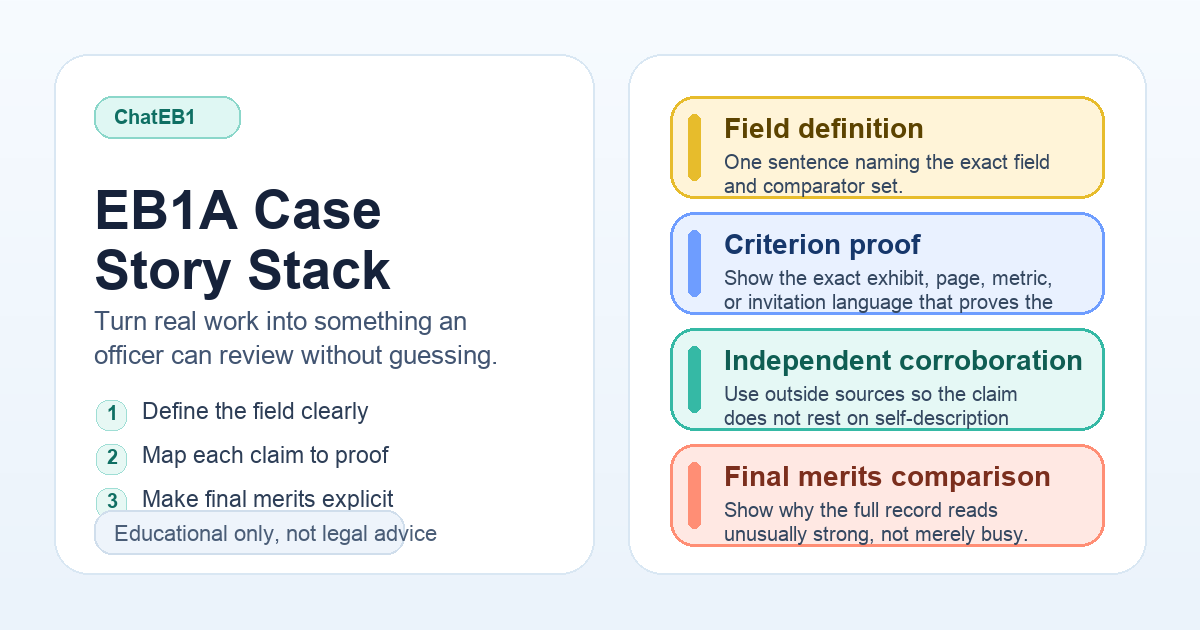
An officer-readable case story does something simpler. It tells the reviewer what field they are judging, what each exhibit proves, which outside sources make the claim believable, and why the whole record still looks uncommon at final merits.
Start with one field sentence
If the field itself stays fuzzy, everything downstream gets harder. Before you write a criterion section, write one sentence that defines the field narrowly enough to be reviewable.
A useful field sentence usually names the lane, the type of work, and the context where the distinction matters. For example:
The petitioner works in production machine-learning systems for consumer-scale ranking and trust products, with impact measured by adoption, model performance, and business-critical deployment inside top technology platforms.
That sentence does not win the case by itself. It simply stops the packet from drifting into a vague "works in AI" story where the officer has to invent the comparator set on their own.
Then convert every major achievement into a proof row
Once the field is defined, stop writing in paragraph-only mode. Build one proof row per major claim.
| Layer | Question to answer | What belongs there |
|---|---|---|
| Field definition | What exact arena is the officer judging? | One clean sentence naming the field and relevant comparator set. |
| Criterion proof | What fact satisfies the criterion? | Invitation language, citation data, award terms, role scope, adoption metrics, or article text. |
| Independent corroboration | Why should the officer trust this beyond your own narration? | Third-party press, outside metrics, independent letters, public product evidence, or peer references. |
| Final merits comparison | Why does the whole record still read as unusually strong? | Comparator logic, field rarity, sustained impact, and cross-signal reinforcement. |
This is the move people often skip. They stop after "criterion proof" and assume the officer will do the comparative work for them.
Why biography makes the packet weaker
A biography is organized around your life. A case story is organized around officer judgment.
- Biography mode: role by role, company by company, accomplishment by accomplishment.
- Case-story mode: claim, proof, outside corroboration, why that proof matters in the field.
Biography is still useful for orientation. It just cannot be the main logic layer. Once the packet starts sounding like a resume with adjectives, the officer has to do too much rebuilding work.
What independent corroboration looks like
This is where many otherwise impressive cases wobble. The petitioner knows the work mattered, but the file still leans too hard on internal description or friendly letters.
Independent corroboration can take several forms:
- Judging: invitation language that shows why you were selected, plus evidence that the platform or venue is real.
- Original contribution: independent adoption, downstream use, public references, external metrics, or outcomes other people can verify.
- Critical role: evidence that the organization mattered and your role affected a meaningful part of it.
- Published material: coverage that is actually about you or your work, not just self-controlled PR.
The question is not whether each document sounds flattering. The question is whether a skeptical officer can see why the claim survives after self-serving narration is stripped away.
A simple example
Suppose you worked on a ranking system at a major company and want to use it for original contribution and critical role. A weak story says:
I worked on important machine-learning systems used by millions of users and played a key role in launching major improvements.
A stronger proof row says:
| Element | Officer-readable version |
|---|---|
| Claim | The petitioner led a ranking-model improvement used in a production surface with significant user and business importance. |
| Criterion proof | Launch memo, architecture review, impact metrics, and role assignment showing ownership. |
| Independent corroboration | Public company statements about the surface, independent letters from collaborators, and metrics that match the claimed timeline. |
| Final merits logic | The work was not routine execution; it affected a high-stakes product surface inside a top platform and produced outcomes outside ordinary peer-level scope. |
Letters should support the row, not replace it
Recommendation letters help most when they explain something the officer cannot see directly from the exhibits. They help less when they simply repeat your own conclusion in better prose.
Ask whether each letter adds one of these:
- a clear reason the writer is credible
- a specific fact the exhibits do not already make obvious
- a field-level comparator judgment the officer would otherwise have to infer
If the letter cannot do one of those jobs, it is probably support material, not a load-bearing proof layer.
Use the five-minute officer test
Before you file, hand each criterion section this quick test:
- Can the officer tell what field they are judging in one sentence?
- Can they see what exact fact satisfies the criterion?
- Can they find one independent reason to trust the claim?
- Can they understand why this matters beyond ordinary success?
- Can they verify the whole thing without hunting through unrelated exhibits?
If the answer is no on any one of those, the packet probably needs stronger packaging before it needs more pages.
Use tools for structure, not exaggeration
Tools are useful when they turn a messy record into proof rows, surface unsupported leaps, and rewrite weak criterion summaries into clearer officer-facing logic. They are harmful when they inflate significance faster than the evidence can support it.
The safe rule is simple: use tools to sharpen structure, not to invent distinction. Every sentence still has to survive document-level verification.
Which ChatEB1 path fits this problem?
If this article made the issue clear but the buying decision still feels fuzzy, use the smallest paid step that matches the job.
| Your current state | Best next path | Why |
|---|---|---|
| You are not sure the record is strong enough to file. | Profile Builder Pro | It keeps the decision at profile strength, evidence gaps, and whether the case is worth organizing further before you pay for full packet build. |
| The evidence is real, but the packet still feels hard to read. | Self-Filer End to End Guide | It focuses on exhibit order, proof rows, letter logic, and final-merits structure, and it comes with the redacted approval-template packet. |
| USCIS already sent an RFE or NOID. | RFE Reconstruction Kit | It is built for objection-by-objection response work under officer pressure. |
If none of those descriptions fits, do not buy blind. Use the sample preview or the Profile Builder Pro first.
Bottom line
Strong EB1A work does not automatically become a strong EB1A case. The difference is whether the officer can follow the story: field definition, criterion proof, independent corroboration, and final-merits comparison.
If your packet still feels biography-heavy, start with the sample preview. If you want a sharper early read on whether the record is ready to package, use the Profile Builder Pro. If the evidence is real but messy, Self-Filer End to End Guide is the direct packet-build step. If you still need profile-strength judgment first, use Profile Builder Pro.